

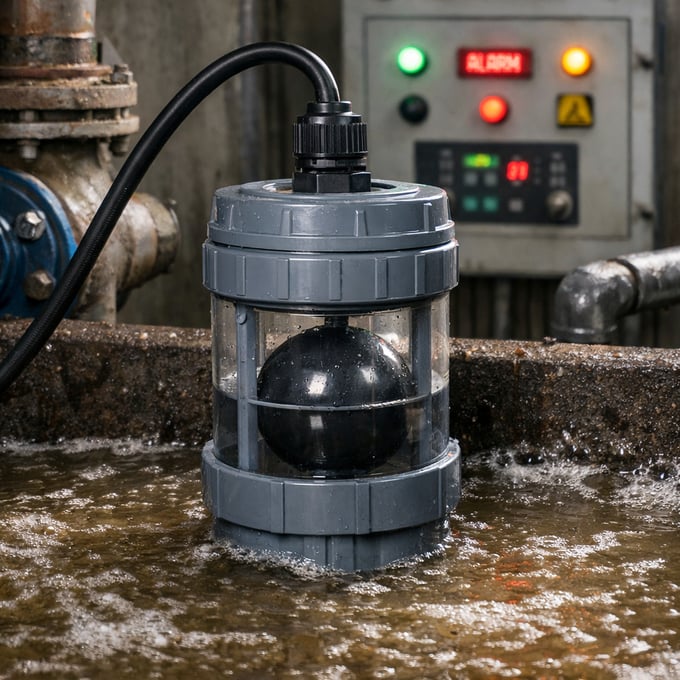
Contact Type Float Switches: The Complete Guide for Wastewater Applications


Contact Type Float Switches: The Complete Guide for Wastewater Applications
In wastewater management, reliable level control is not just important—it's critical. Contact type float switches have emerged as a cornerstone technology in this field, providing dependable liquid level detection that helps prevent system failures and environmental disasters. This comprehensive guide will explore everything you need to know about contact type float switches, from their basic operation to advanced applications in wastewater treatment.
What Is a Contact Type Float Switch?
A contact type float switch is a mechanical device that uses a floating mechanism to detect liquid levels and trigger electrical contacts. As the liquid level rises or falls, the float moves accordingly, activating or deactivating an electrical circuit. These switches are fundamental components in pump control systems, particularly in wastewater applications.
Core Components of Contact Type Float Switches
| Component | Function |
|---|---|
| Float Chamber | Houses the buoyant mechanism that responds to liquid level changes |
| Electrical Contacts | Creates or breaks the electrical circuit based on float position |
| Cable Assembly | Connects the switch to the control system and provides power |
| Mounting Hardware | Secures the float switch at the desired activation level |
Operating Principles of Contact Type Float Switches
Contact type float switches operate on a straightforward principle: buoyancy. When liquid reaches a predetermined level, the float rises or falls, causing internal mechanisms to either make or break an electrical connection. This simple yet effective design has made them a reliable choice for decades in wastewater applications.
Types of Contact Configurations
Different applications require different contact configurations:
- Normally Open (NO): Contacts close when the float rises
- Normally Closed (NC): Contacts open when the float rises
- Single Pole, Double Throw (SPDT): Offers both NO and NC operations in one unit
Applications in Wastewater Treatment
Contact type float switches play crucial roles throughout wastewater treatment facilities:
Primary Applications
- Pump Control: Automating pump operation based on tank levels
- High-Level Alarms: Alerting operators to potential overflow conditions
- Low-Level Protection: Preventing pump dry-running
- Sequential Operation: Controlling multiple pumps in larger systems
Advantages of Contact Type Float Switches
Understanding the benefits of contact type float switches helps explain their enduring popularity in wastewater applications:
| Advantage | Benefit |
|---|---|
| Mechanical Simplicity | Lower maintenance requirements and fewer points of failure |
| Cost-Effectiveness | Excellent value for reliable level control |
| Durability | Resistant to harsh wastewater environments |
| Easy Installation | Minimal setup time and configuration required |
Installation Best Practices
Proper installation is crucial for optimal performance of contact type float switches. Consider these key factors:
Mounting Considerations
The mounting location and method significantly impact switch performance:
- Install away from turbulent areas and incoming flows
- Maintain adequate clearance from tank walls and other obstacles
- Ensure proper cable management to prevent tangling
- Use appropriate mounting brackets or weighted systems
Maintenance and Troubleshooting
Regular maintenance ensures long-term reliability of contact type float switches:
Maintenance Schedule
| Task | Frequency | Purpose |
|---|---|---|
| Visual Inspection | Monthly | Check for physical damage or debris |
| Operation Test | Quarterly | Verify proper switching action |
| Cable Inspection | Semi-annually | Check for wear or damage |
| Complete System Check | Annually | Comprehensive performance verification |
Selecting the Right Contact Type Float Switch
Choose the appropriate float switch by considering these factors:
- Liquid specific gravity and chemical composition
- Required switching action (NO/NC/SPDT)
- Environmental conditions
- Regulatory requirements
- System voltage and current requirements
Integration with Control Systems
Modern wastewater facilities often integrate contact type float switches with sophisticated control systems. This integration can include:
- SCADA system connectivity
- Remote monitoring capabilities
- Data logging and trend analysis
- Automated alarm notification
Safety Considerations
Safety is paramount when working with contact type float switches in wastewater applications:
- Always follow proper lockout/tagout procedures
- Use appropriate personal protective equipment (PPE)
- Ensure proper grounding and electrical safety
- Maintain compliance with local safety regulations
Future Trends and Innovations
The future of contact type float switches includes several exciting developments:
- Smart diagnostics and self-monitoring capabilities
- Enhanced materials for improved durability
- Integration with IoT platforms
- Advanced communication protocols
Conclusion
Contact type float switches remain a cornerstone technology in wastewater treatment applications, offering reliability, simplicity, and cost-effectiveness. Understanding their operation, proper installation, and maintenance requirements ensures optimal performance and longevity. As technology advances, these devices continue to evolve while maintaining their essential role in liquid level control.
Recommended Internal Links:
- Pump Control Systems
- Level Monitoring Solutions
- Wastewater Treatment Equipment
- Industrial Automation Controls
- SCADA Integration