

RTD Sensors: The Complete Guide to Resistance Temperature Detectors in Industrial Applications


RTD Sensors: The Complete Guide to Resistance Temperature Detectors in Industrial Applications
Temperature monitoring is crucial in industrial processes, and choosing the right temperature sensor can make the difference between optimal operation and costly failures. RTD sensors (Resistance Temperature Detectors) have emerged as the go-to solution for precise temperature measurement in demanding industrial environments. This comprehensive guide will explore everything you need to know about RTD sensors, from their fundamental principles to practical applications in wastewater treatment and industrial automation.
What is an RTD Sensor?
An RTD sensor is a precision temperature measurement device that operates on the principle that electrical resistance in metals changes predictably with temperature. The most common type uses platinum as its sensing element, known as the Pt100 RTD sensor, which has a resistance of 100 ohms at 0°C. As temperature increases, the resistance increases in a nearly linear relationship.
Key Components of an RTD Sensor
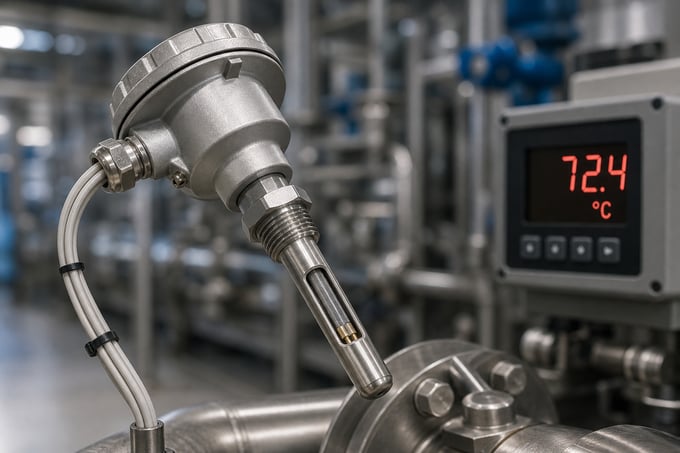
A typical RTD sensor consists of:
- Sensing element (usually platinum, nickel, or copper)
- Lead wires for electrical connection
- Protective sheath or housing
- Terminal head or connection point
Types of RTD Sensors
| RTD Type | Material | Temperature Range | Accuracy |
|---|---|---|---|
| Pt100 | Platinum | -200°C to 650°C | ±0.1°C |
| Pt1000 | Platinum | -200°C to 650°C | ±0.1°C |
| Nickel | Nickel | -60°C to 180°C | ±0.5°C |
| Copper | Copper | -50°C to 150°C | ±0.5°C |
Advantages of RTD Sensors in Industrial Applications
RTD sensors offer several distinct advantages that make them ideal for industrial applications:
1. Superior Accuracy
RTD sensors provide exceptional accuracy, typically ±0.1°C across their operating range. This precision is crucial in processes where temperature control directly impacts product quality or system efficiency.
2. Excellent Stability
Unlike thermocouples, RTD sensors maintain their calibration over long periods, reducing maintenance requirements and ensuring reliable measurements year after year.
3. Wide Temperature Range
Industrial-grade RTD sensors can measure temperatures from -200°C to 650°C, making them suitable for diverse applications from cryogenic processes to high-temperature operations.
RTD Sensors in Wastewater Treatment
In wastewater treatment facilities, RTD sensors play a vital role in monitoring and controlling various processes. Temperature measurement is critical for:
Biological Treatment Processes
Maintaining optimal temperature ranges for bacterial activity in biological treatment processes is essential for efficient wastewater treatment. RTD sensors provide accurate temperature monitoring that helps operators maintain ideal conditions for biological breakdown of waste materials.
Sludge Treatment
During anaerobic digestion and other sludge treatment processes, temperature control is crucial for maximizing methane production and ensuring proper stabilization. RTD sensors help maintain the precise temperature conditions required for these processes.
Integration with SCADA Systems
Modern RTD sensors can be seamlessly integrated with SCADA systems for comprehensive process monitoring and control. At RACO Manufacturing & Engineering, we recommend connecting RTD sensors to our AlarmAgent® remote monitoring systems for real-time temperature data acquisition and alarm notification.
Key Integration Features:
- 4-20mA or digital output compatibility
- Remote temperature monitoring capabilities
- Automated alarm notification when temperature exceeds specified ranges
- Data logging for trend analysis and regulatory compliance
Installation and Maintenance Best Practices
Proper installation and maintenance of RTD sensors are crucial for optimal performance:
Installation Guidelines
1. Select appropriate mounting location for accurate process temperature measurement
2. Ensure proper immersion depth for liquid temperature monitoring
3. Use appropriate wire gauge and connection methods
4. Implement proper grounding and shielding techniques
Maintenance Requirements
1. Regular calibration checks (typically annually)
2. Inspection of protective sheaths for damage
3. Verification of electrical connections
4. Documentation of calibration and maintenance activities
Troubleshooting Common RTD Sensor Issues
| Issue | Possible Cause | Solution |
|---|---|---|
| Erratic Readings | Loose connections or interference | Check wiring and shielding |
| Slow Response | Poor thermal contact or buildup | Clean sensor and verify installation |
| Drift in Readings | Sensor contamination or aging | Recalibrate or replace sensor |
Conclusion
RTD sensors are indispensable tools in industrial temperature measurement, offering superior accuracy, stability, and reliability. Their integration with modern monitoring systems, such as RACO's AlarmAgent®, provides comprehensive temperature monitoring solutions for wastewater treatment and other industrial applications. Understanding their principles, proper installation, and maintenance requirements ensures optimal performance and longevity of these crucial measurement devices.
For more information about integrating RTD sensors with RACO's remote monitoring solutions, contact our technical support team or visit our product documentation section.
Recommended Internal Links:
- SCADA Systems
- Remote Monitoring Solutions
- Industrial Automation
- Temperature Monitoring
- Wastewater Treatment Solutions