


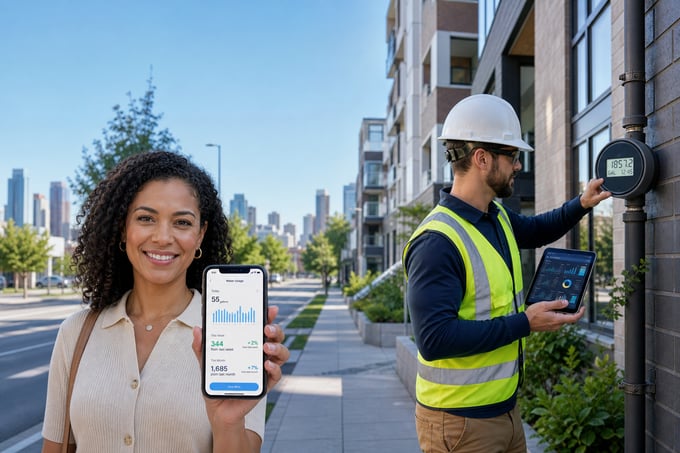
Advanced Metering Infrastructure (AMI): The Complete Guide for Water Utilities


Advanced Metering Infrastructure (AMI): The Complete Guide for Water Utilities
The water utility industry is undergoing a dramatic transformation, driven by the need for greater efficiency, improved customer service, and sustainable resource management. At the heart of this evolution lies Advanced Metering Infrastructure (AMI), a revolutionary technology that's reshaping how utilities monitor, manage, and optimize their water distribution networks.
What is Advanced Metering Infrastructure?
Advanced Metering Infrastructure represents a comprehensive system that integrates smart meters, communications networks, and data management systems to enable two-way communication between utilities and their customers. Unlike traditional manual meter reading or even Automated Meter Reading (AMR) systems, AMI provides real-time data collection, analysis, and control capabilities.
| Component | Function |
|---|---|
| Smart Meters | Digital meters that measure consumption and operational parameters |
| Communication Network | Infrastructure that enables data transmission between meters and utility |
| Data Management System | Software that processes and analyzes collected data |
| Customer Interface | Portals and apps that provide consumption information to end-users |
Key Benefits of AMI Implementation
1. Enhanced Operational Efficiency
AMI systems dramatically reduce the need for manual meter reading, virtually eliminating reading errors and significantly cutting operational costs. Utilities can monitor their distribution network in real-time, quickly identifying and responding to issues like leaks or pressure anomalies.
2. Improved Customer Service
With AMI, customers gain unprecedented visibility into their water usage patterns. Through user-friendly interfaces, they can:
- Monitor real-time consumption
- Receive alerts about potential leaks
- Access detailed usage history
- Set consumption goals and receive progress updates
3. Conservation and Sustainability
Advanced Metering Infrastructure plays a crucial role in water conservation efforts. The system's ability to detect leaks early and provide detailed consumption data helps utilities and customers work together to reduce water waste and promote sustainable usage patterns.
Essential Components of an AMI System
Smart Meters
Modern smart meters do more than measure water flow. They can detect reverse flow, tampering attempts, and various operational parameters. Leading manufacturers equip their meters with:
- High-precision measurement capabilities
- Built-in communication modules
- Long-lasting battery life
- Robust environmental protection
Communication Infrastructure
The communication network is the backbone of any AMI system. Several technologies are commonly used:
| Technology | Advantages | Best Used For |
|---|---|---|
| Radio Frequency (RF) Mesh | Reliable, self-healing network | Dense urban areas |
| Cellular | Existing infrastructure, wide coverage | Rural or scattered service areas |
| LoRaWAN | Long range, low power consumption | Mixed urban/rural deployments |
Data Management and Analytics
The true power of AMI lies in its data management capabilities. Modern systems employ sophisticated analytics platforms that can:
1. Operational Analytics
Advanced algorithms process vast amounts of data to provide actionable insights, including:
- Predictive maintenance scheduling
- Distribution network optimization
- Resource allocation improvements
- Demand forecasting
2. Customer Analytics
Customer-focused analytics help utilities better serve their communities by:
- Identifying unusual consumption patterns
- Personalizing conservation recommendations
- Segmenting customers for targeted programs
- Improving billing accuracy
Implementation Considerations
Successfully deploying an AMI system requires careful planning and consideration of several key factors:
1. Infrastructure Assessment
Before implementation, utilities must evaluate their existing infrastructure and determine necessary upgrades. This includes assessing:
- Current meter conditions and replacement needs
- Communication network requirements
- Data storage and processing capabilities
- Integration with existing systems
2. Security Considerations
As with any connected system, cybersecurity is paramount. Key security measures include:
- End-to-end encryption
- Regular security audits
- Access control systems
- Compliance with industry standards
Integration with SCADA Systems
Modern AMI systems often integrate with Supervisory Control and Data Acquisition (SCADA) systems to provide comprehensive utility management. This integration enables:
- Centralized control and monitoring
- Automated alarm management
- Enhanced data analysis capabilities
- Improved emergency response
Future Trends in AMI
The future of Advanced Metering Infrastructure is evolving rapidly, with several emerging trends:
1. Artificial Intelligence and Machine Learning
AI and ML algorithms are increasingly being used to:
- Predict equipment failures
- Optimize network performance
- Enhance customer service
- Improve resource management
2. Internet of Things (IoT) Integration
Integration with IoT devices and sensors is expanding AMI capabilities to include:
- Environmental monitoring
- Water quality tracking
- Infrastructure health monitoring
- Smart city integration


