

Pressure Sensing: A Comprehensive Guide to Industrial Applications and Technology


Pressure Sensing: A Comprehensive Guide to Industrial Applications and Technology
In the complex world of industrial automation and process control, pressure sensing stands as a cornerstone technology that drives efficiency, safety, and reliability across numerous applications. Whether you're managing a wastewater treatment facility, overseeing manufacturing processes, or maintaining critical infrastructure, understanding pressure sensing is crucial for optimal system performance.
Understanding Pressure Sensing Fundamentals
Pressure sensing technology measures the force per unit area applied to a surface. In industrial applications, this measurement is critical for monitoring and controlling various processes. The technology has evolved significantly from simple mechanical gauges to sophisticated electronic sensors that provide real-time data and integration with modern control systems.
| Pressure Type | Description | Common Applications |
|---|---|---|
| Absolute Pressure | Measured relative to perfect vacuum | Altitude measurement, vacuum processes |
| Gauge Pressure | Measured relative to atmospheric pressure | Tire pressure, hydraulic systems |
| Differential Pressure | Difference between two pressure points | Flow measurement, filter monitoring |
Key Components of Modern Pressure Sensing Systems
Modern pressure sensing systems comprise several essential components that work together to provide accurate and reliable measurements:
1. Sensing Element
The primary component that directly interacts with the medium being measured. Common types include:
- Piezoresistive sensors - Capacitive sensors - Strain gauge sensors - Resonant wire sensors2. Signal Conditioning
Electronics that convert the raw sensor output into usable electrical signals, including amplification and filtering circuits.
3. Output Interface
The means by which the sensor communicates with control systems, whether through analog signals (4-20mA, 0-10V) or digital protocols (HART, Modbus).
Applications in Wastewater Treatment
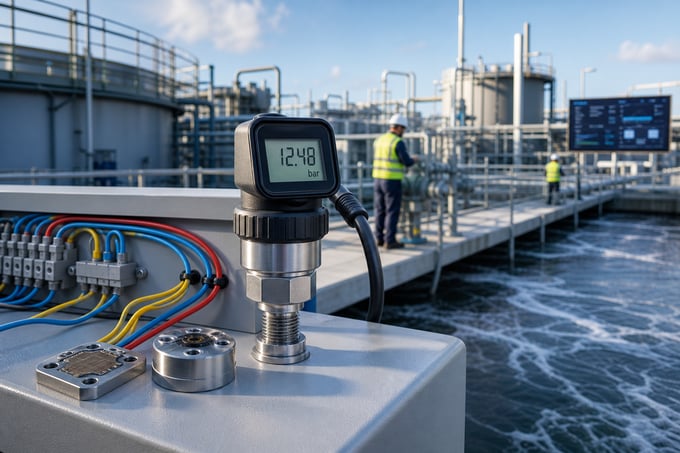
In wastewater treatment facilities, pressure sensing plays a vital role in multiple processes:
Pump Station Monitoring
Pressure sensors monitor pump performance and prevent issues like cavitation or deadheading. They're essential for maintaining optimal flow rates and protecting expensive equipment.
Level Measurement
Hydrostatic pressure sensors provide accurate level measurements in tanks and basins, crucial for process control and overflow prevention.
Filter Performance
Differential pressure sensors monitor filter condition by measuring pressure drops across filter media, indicating when maintenance is required.
Industrial Automation Applications
Beyond wastewater treatment, pressure sensing is crucial in various industrial automation scenarios:
| Industry | Application | Benefits |
|---|---|---|
| Manufacturing | Hydraulic system monitoring | Prevents system failures, ensures optimal performance |
| Oil & Gas | Pipeline monitoring | Leak detection, flow optimization |
| Power Generation | Boiler pressure monitoring | Safety assurance, efficiency optimization |
Best Practices for Pressure Sensor Selection
Choosing the right pressure sensor requires careful consideration of several factors:
Environmental Considerations
Evaluate the operating environment, including:
- Temperature ranges - Chemical compatibility - Vibration exposure - Moisture and dust exposurePerformance Requirements
Consider critical specifications such as:
- Accuracy needs - Response time - Pressure range - Long-term stabilityIntegration with Control Systems
Modern pressure sensors must seamlessly integrate with existing control systems. This integration typically involves:
Communication Protocols
Select sensors compatible with your control system's communication requirements, whether it's:
- Traditional 4-20mA loops - Digital protocols like HART or Modbus - Wireless communication optionsData Management
Consider how pressure data will be:
- Collected and stored - Analyzed for trends - Used for predictive maintenance - Integrated with SCADA systemsMaintenance and Calibration
Regular maintenance and calibration are essential for reliable pressure sensing systems. Key considerations include:
Calibration Schedule
Develop a calibration program based on:
- Manufacturer recommendations - Application criticality - Regulatory requirements - Historical performance dataPreventive Maintenance
Implement routine checks for:
- Physical damage - Electrical connections - Environmental protection - Documentation and recordsFuture Trends in Pressure Sensing
The pressure sensing industry continues to evolve with emerging technologies:
Smart Sensors
Integration of advanced features like:
- Self-diagnostics - Wireless connectivity - Edge computing capabilities - Predictive maintenance algorithmsIoT Integration
Enhanced connectivity enabling:
- Remote monitoring - Cloud-based analytics - Real-time optimization - Automated reportingConclusion
Pressure sensing technology remains a critical component in industrial automation and process control. Understanding its applications, selection criteria, and maintenance requirements is essential for optimal system performance. As technology continues to advance, pressure sensing systems will become increasingly intelligent and integrated, offering new opportunities for process optimization and efficiency improvements.
For expert guidance on pressure sensing solutions for your specific application, contact RACO Manufacturing & Engineering. Our team of specialists can help you select and implement the right pressure sensing technology for your needs.