


Contact Switches: A Comprehensive Guide to Industrial Applications and Benefits


Contact Switches: A Comprehensive Guide to Industrial Applications and Benefits
In the complex world of industrial automation and control systems, contact switches play a fundamental role in ensuring reliable operation and safety. These essential components serve as the backbone of many electrical circuits, enabling critical functions in wastewater treatment facilities, manufacturing plants, and various industrial applications. Understanding how contact switches work and their diverse applications can help facility managers make informed decisions about their control systems.
What Is a Contact Switch?
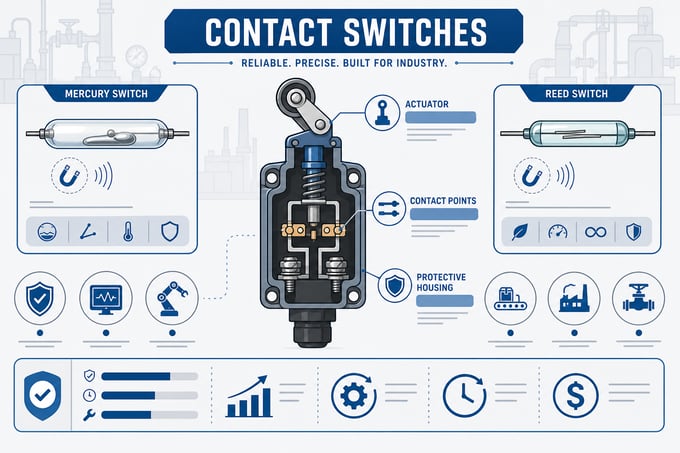
A contact switch, also known as a switching contact or electrical contact, is a device that controls the flow of electricity in a circuit by making or breaking electrical connections. These switches consist of conducting components that either touch to complete a circuit (closed position) or separate to break it (open position).
| Contact Switch Component | Function |
|---|---|
| Contact Points | Conducting surfaces that make or break the electrical connection |
| Actuator | Mechanism that triggers the switching action |
| Housing | Protective enclosure that ensures safe operation |
Types of Contact Switches in Industrial Applications
Industrial environments utilize various types of contact switches, each designed for specific applications and operating conditions:
1. Mechanical Contact Switches
These traditional switches rely on physical movement to make or break electrical connections. They're commonly used in:
- Level monitoring systems - Door position sensors - Emergency stop buttons - Equipment safety interlocks2. Mercury Contact Switches
Though less common today due to environmental concerns, mercury switches offer unique benefits in specific applications:
- Tilt detection systems - Float-based level controls - Motion-sensitive devices - Temperature control systems3. Reed Contact Switches
Reed switches use magnetic fields to activate contacts, making them ideal for:
- Proximity detection - Flow monitoring - Position sensing - Security systemsCritical Applications in Wastewater Treatment
In wastewater treatment facilities, contact switches serve several vital functions:
Level Monitoring and Control
Contact switches play a crucial role in maintaining proper fluid levels within treatment tanks and basins. When integrated with advanced monitoring systems like RACO's Verbatim Gateway, these switches provide real-time data and alerts for:
- High-level conditions - Pump activation points - Overflow prevention - Process control sequencesEquipment Protection
Contact switches help protect valuable equipment by:
- Preventing dry-running conditions in pumps - Monitoring bearing temperatures - Detecting excessive vibration - Ensuring proper valve positions| Application | Contact Switch Type | Benefits |
|---|---|---|
| Pump Control | Float Switch | Reliable level detection, maintenance-free operation |
| Safety Interlocks | Mechanical Switch | Positive indication, fail-safe operation |
| Flow Monitoring | Reed Switch | Non-contact operation, long service life |
Integration with Modern Control Systems
Modern industrial facilities benefit from integrating contact switches with advanced monitoring and control systems. RACO's alarm monitoring solutions, for example, can receive inputs from various contact switches to:
- Generate immediate alerts for critical conditions - Log operational data for analysis - Enable remote monitoring capabilities - Support predictive maintenance programsSelection Criteria for Industrial Contact Switches
When selecting contact switches for industrial applications, consider these key factors:
Environmental Considerations
Industrial environments often present challenging conditions that affect switch performance:
- Temperature extremes - Humidity and moisture exposure - Corrosive atmospheres - Explosive environmentsElectrical Requirements
Match switch specifications to your application needs:
- Voltage and current ratings - Switching frequency - Contact resistance - Insulation requirementsMaintenance and Troubleshooting
Regular maintenance of contact switches ensures reliable operation and extends service life. Key maintenance activities include:
| Maintenance Task | Frequency | Purpose |
|---|---|---|
| Visual Inspection | Monthly | Check for physical damage or wear |
| Contact Cleaning | Quarterly | Remove oxidation and contamination |
| Operation Testing | Semi-annually | Verify proper switching function |
Future Trends in Contact Switch Technology
The evolution of industrial automation continues to drive innovations in contact switch design and application:
- Integration with Industrial Internet of Things (IIoT) platforms - Enhanced diagnostic capabilities - Improved materials for longer service life - Smart switching technologies with embedded sensorsConclusion
Contact switches remain essential components in industrial control systems, particularly in wastewater treatment applications. Their reliable operation, when properly selected and maintained, ensures safe and efficient facility operation. By understanding the various types, applications, and maintenance requirements of contact switches, facility managers can make informed decisions about their control system components.
For more information about integrating contact switches with advanced monitoring systems, explore RACO's range of alarm monitoring solutions or contact our technical experts for personalized guidance.


