

Dry Contacts in Industrial Control Systems: A Complete Guide to Reliable Electrical Switching


Dry Contacts in Industrial Control Systems: A Complete Guide to Reliable Electrical Switching
In the complex world of industrial automation and control systems, dry contacts play a crucial yet often misunderstood role. Whether you're managing a wastewater treatment facility, overseeing manufacturing operations, or maintaining critical infrastructure, understanding dry contacts is essential for ensuring reliable system operation and effective monitoring.
What Is a Dry Contact?
A dry contact, also known as a voltage-free contact or potential-free contact, is a switching mechanism that doesn't carry an electrical load in its default state. Unlike "wet" contacts, which have voltage present, dry contacts are isolated from the power source until activated. Think of it as a simple switch that either completes or breaks a circuit without providing power itself.
Key Characteristics of Dry Contacts:
| Characteristic | Description |
|---|---|
| Electrical Isolation | Complete separation from power source |
| Switching Action | Simple open/close mechanism |
| Power Requirements | No internal power source |
| Compatibility | Works with various voltage levels |
Applications of Dry Contacts in Industrial Settings
Dry contacts find extensive use across various industrial applications, particularly in monitoring and control systems. Their versatility and reliability make them invaluable for:
1. Wastewater Treatment Facilities
In wastewater management, dry contacts are essential for:
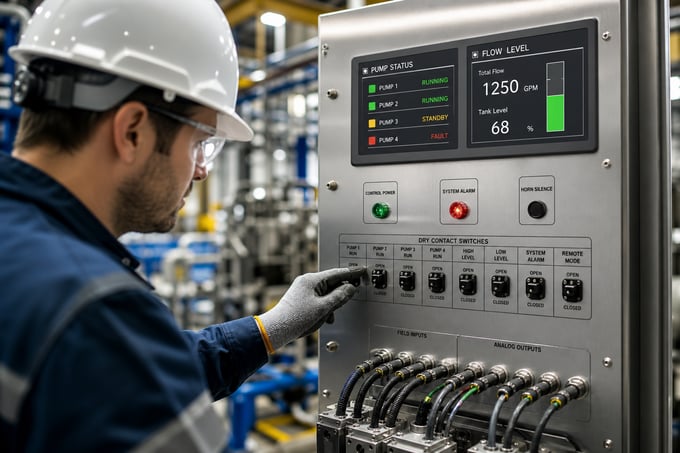
- Pump status monitoring - Level sensor integration - Alarm system activation - Flow meter signal transmission2. Manufacturing Operations
Manufacturing facilities rely on dry contacts for:
- Equipment status indication - Production line monitoring - Safety system integration - Process control coordinationAdvantages of Using Dry Contacts
Understanding the benefits of dry contacts helps explain their widespread adoption in industrial applications:
1. Enhanced Safety
The inherent electrical isolation of dry contacts provides an additional layer of safety by preventing direct exposure to power sources. This isolation is particularly crucial in hazardous environments or when dealing with sensitive equipment.
2. Universal Compatibility
Dry contacts can interface with various voltage levels and control systems, making them highly versatile for different applications. This compatibility eliminates the need for complex voltage matching or signal conversion.
3. Reliability and Longevity
With no internal power source to fail and minimal moving parts, dry contacts offer exceptional reliability and extended service life. This reliability is crucial for critical infrastructure and continuous operations.
Integration with Modern Control Systems
Modern industrial control systems often combine traditional dry contacts with advanced digital technologies. This integration provides several advantages:
| Feature | Benefit |
|---|---|
| Remote Monitoring | Real-time status updates and control capabilities |
| Data Logging | Historical performance tracking and analysis |
| Automated Response | Programmed actions based on contact status |
| System Integration | Seamless incorporation with SCADA systems |
Best Practices for Implementing Dry Contacts
To maximize the effectiveness of dry contacts in your industrial control system:
1. Proper Installation
Ensure correct wiring and connection practices to maintain the integrity of the electrical isolation. This includes using appropriate wire gauges and maintaining proper terminal connections.
2. Regular Maintenance
Implement a preventive maintenance schedule that includes:
- Visual inspection of contact points - Testing of switching functionality - Verification of isolation integrity - Cleaning of contact surfaces when necessary3. Documentation
Maintain detailed records of:
- Installation configurations - Maintenance activities - System modifications - Performance historyTroubleshooting Common Issues
Even reliable dry contacts can experience issues. Here's how to address common problems:
| Issue | Possible Cause | Solution |
|---|---|---|
| Contact Failure | Mechanical wear or contamination | Clean or replace contacts |
| False Signals | Electromagnetic interference | Improve shielding |
| Intermittent Operation | Loose connections | Tighten terminals |
Future Trends in Dry Contact Technology
The evolution of industrial automation continues to influence dry contact applications:
1. Smart Integration
Modern systems increasingly incorporate intelligent monitoring capabilities with traditional dry contact functionality, enabling advanced diagnostics and predictive maintenance.
2. IoT Connectivity
Integration with Internet of Things (IoT) platforms allows for enhanced remote monitoring and control capabilities, making systems more efficient and responsive.
Conclusion
Dry contacts remain a fundamental component in industrial control systems, offering reliability, safety, and versatility. Their simple yet effective operation makes them indispensable in modern industrial applications, from wastewater treatment to manufacturing processes.
For more information about implementing dry contacts in your industrial control system or to explore advanced monitoring solutions, contact RACO Manufacturing & Engineering. Our experts can help you design and implement a system that meets your specific needs while ensuring optimal performance and reliability.