Key takeaways
- RACO AlarmAgent provides a trusted backup to SCADA, catching problems that might otherwise be missed.
- During major storms and communications outages, the alarms helped Valdosta keep watch over critical lift stations.
The challenge
Nobody calls the sewer department to say everything's fine.
Randy Jones, superintendent of lift stations for the City of Valdosta, Georgia, puts it plainly: “There’s one thing about sewer. Nobody knows anything about it as long as it stays in the pipes.” The moment it doesn’t, the whole community notices, and the questions start.
Valdosta sits in extreme South Georgia, 20 miles north of the Florida line on I-75. The terrain is nearly flat, which means gravity does the crew no favors: 35 lift stations, spread across some 20 miles north to south, keep the city’s wastewater moving, with five more stations on the way. Two master stations, Gornto and Remerton, act as the headworks for one of the city’s wastewater plants, moving 4 to 4.5 million gallons on a good day.
Covering all of it: two lift station operators (a third is coming), three electronic systems techs, and Emily Arnold, the electronic systems supervisor who keeps the alarm network alive.
“RACO has saved the day, to put it plainly, multiple times.”
Alarms that earn a response
Every one of those 35 stations carries a RACO AlarmAgent.
The city also runs a full VT SCADA system, and the relationship between the two might surprise a SCADA integrator. “We use that as technically our backup system,” Randy says. SCADA provides the detail, level trends and operating data. RACO makes the call. When the integrator suggested the city didn’t need RACO anymore, the answer was adamant, and experience has vindicated it. “Our SCADA communications have failed,” Emily says. “RACO has saved the day, to put it plainly, multiple times.”
The department has a standing rule: a RACO call gets a response, every time. SCADA then tells the responder what kind of response. A high level alarm at 15 feet in a 20-foot wet well, holding steady, means head that way. The same alarm after a rain event, with the level at 18 feet, means get there quick. “There’s a difference in responding to an emergency and a difference in responding to a need,” Randy says.
The rule has paid for itself. At one station, housed in the basement of City Hall itself, SCADA showed everything normal. RACO called anyway. The on-call operator checked SCADA, saw nothing wrong, and went regardless. RACO was right. Had he stayed home, the station would have spilled, inside the basement of City Hall.
“The best company that we deal with”
Lift stations are a harsh home for electronics, and when moisture gets into a cabinet, Randy’s crew needs answers fast.
“Best company that we deal with. Literally the best company that we deal with,” he says. “If I pick up the phone and call Kendall or Julie, they are absolutely going to get back with me and they’re going to solve whatever problem.”
That standard of service matches the one his own team sets. When a transducer fails at 2 a.m., Emily comes out, on overtime but never on standby pay, 99.9 percent of the time. People who go that far above and beyond deserve alarms they never have to second-guess.
Their SCADA integrator has suggested, more than once, that the city doesn’t need RACO. Randy’s answer hasn’t changed: “If we get rid of one of y’all, guess who it’s going to be? It ain’t going to be RACO.”
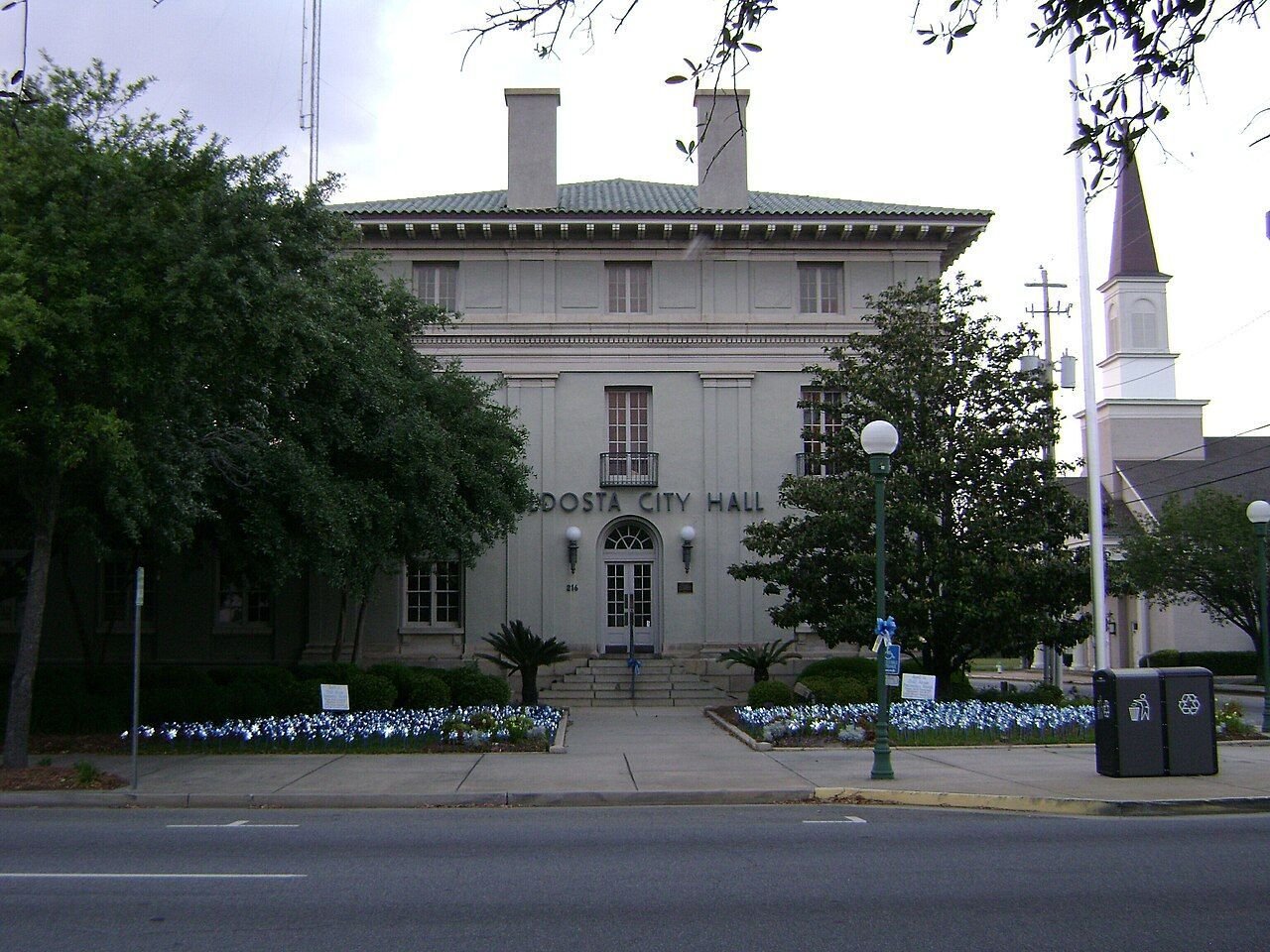
Photo: Mjrmtg, Valdosta City Hall, via Wikimedia Commons, licensed under CC BY-SA 3.0. Unmodified except cropping.